In the limousine, chauffeur, and ground transportation business, every mile and every hour matters.
One of the biggest hidden costs for operators is deadheading — driving a vehicle without a paying passenger.
Deadhead miles cost money through fuel, vehicle wear, chauffeur time, and missed booking opportunities. But there is a smarter approach:
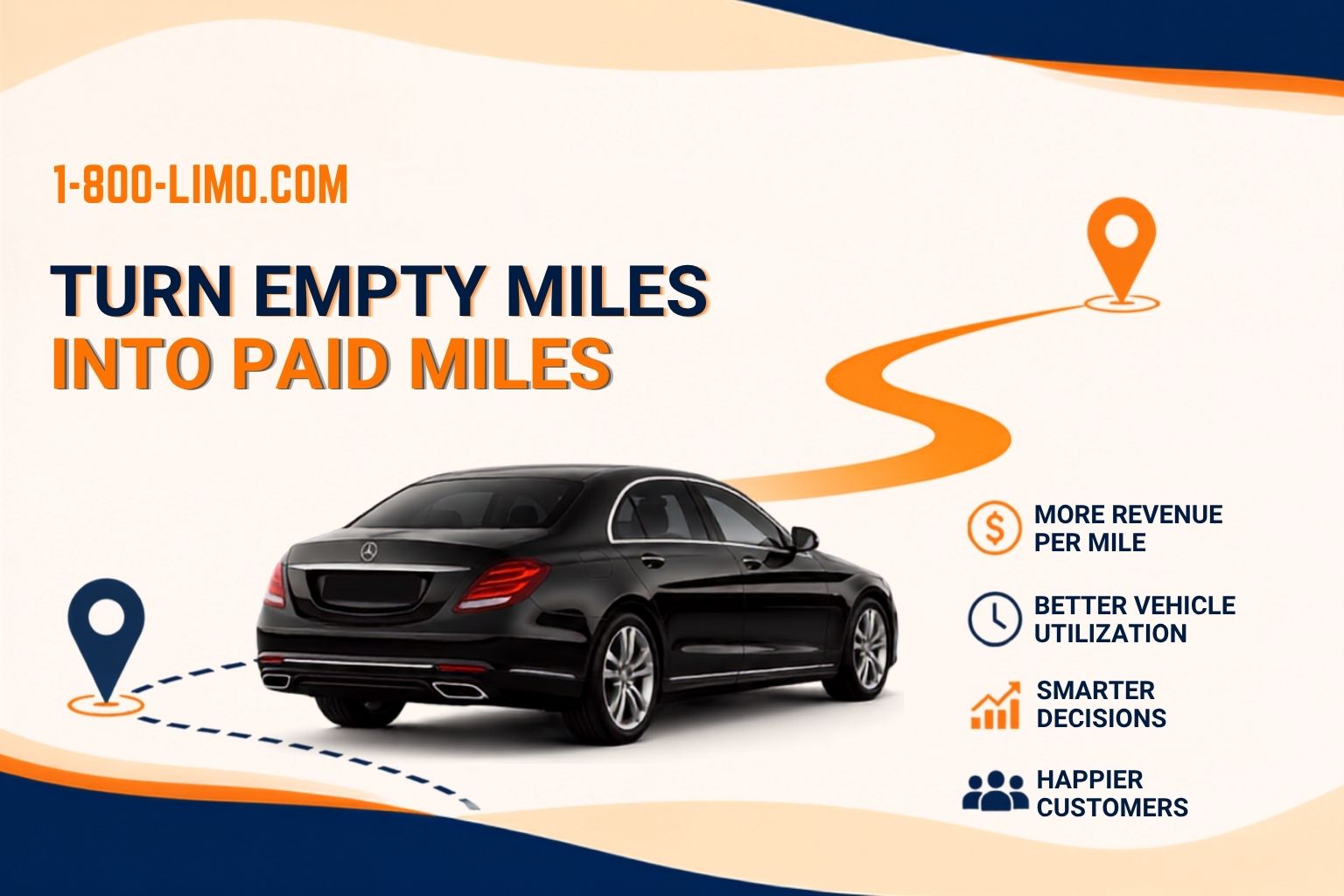
Turn empty miles into paid miles whenever the opportunity makes sense.
For operators using 1800limo.com, this becomes even more powerful when AI-assisted logistics can help manage both prearranged and on-demand bookings, respond to real-time changes, and identify better opportunities as they become available.
What Is Deadheading?
Deadheading occurs whenever a vehicle travels without a passenger.
Common examples include:
- Driving to a pickup location without a passenger
- Returning empty after an airport transfer
- Repositioning for a future reservation
- Returning from a wedding, corporate event, or long-distance trip
- Moving between service areas without a booking
The vehicle is still consuming fuel and accumulating mileage, but it is generating no revenue.
That makes deadheading one of the most important areas for transportation operators to monitor when looking for ways to improve fleet efficiency.
Turn Empty Miles Into Revenue
Consider a simple example.
A vehicle needs to travel 60 miles to reach its next scheduled booking.
If the vehicle drives those 60 miles empty, that movement produces:
$0 in revenue.
Instead, the operator could accept a discounted transfer traveling in the same direction.
For example, if a normal $300 trip is offered at 40% off, the customer pays $180.
The vehicle still travels approximately the same 60 miles, but now the operator earns $180 while positioning the vehicle for its next job.
That’s:
$3 per mile instead of $0 per mile.
The key is not simply offering discounts.
The key is using discounts strategically when the vehicle would otherwise be traveling empty.
Why Strategic Discounting Works
A discounted repositioning trip can improve several important business metrics:
- Higher revenue per mile
- Higher revenue per hour
- Lower deadhead percentage
- Better vehicle utilization
- More productive chauffeur time
- Additional revenue without adding another vehicle
The objective is to make the fleet more productive without unnecessarily increasing fixed costs.
A 30% or 40% discount can make sense when the vehicle is already traveling in that direction and the ride does not interfere with a higher-value reservation.
AI-Powered Logistics: Manage the Fleet in Real Time
Deadhead reduction becomes even more powerful when an AI assistant helps manage logistics in real time.
For both prearranged and on-demand bookings, an AI-powered system can evaluate:
- Vehicle locations
- Chauffeur availability
- Existing schedules
- Upcoming reservations
- Routing
- New ride opportunities
- Timing between bookings
Instead of simply assigning the next available vehicle, the system can look at the overall movement of the fleet and identify opportunities to improve utilization.
The objective is simple:
Keep the vehicle moving toward revenue — not just moving.
Real-Time Changes and Smarter Rerouting
Transportation schedules change constantly.
A customer may change a pickup time. A reservation may be canceled. Traffic may alter the best route. Or a higher-value booking may suddenly become available.
An AI logistics assistant can help evaluate these changes as they happen.
For example, a chauffeur may already be traveling toward an area where a new booking becomes available.
If the new booking is more profitable and can be completed without jeopardizing another reservation, the system can identify the opportunity and suggest or facilitate a reroute according to the operator’s rules.
The result is a more dynamic transportation operation where the fleet can respond to changing demand instead of following a rigid schedule.
Accept the Better Booking
Imagine a chauffeur is scheduled for a lower-value transfer while moving toward a particular service area.
A more profitable booking suddenly becomes available nearby.
Instead of requiring an operator to manually compare locations, schedules, travel times, and revenue, an AI assistant can evaluate the alternatives.
If the new opportunity makes better business sense, the operator can choose the more profitable booking.
This changes the focus from:
“How many bookings did we accept?”
to:
“Did we accept the right bookings?”
That distinction can make a major difference in fleet utilization.
Reject Bookings Without Penalty
Flexibility is just as important as optimization.
Operators should have the ability to reject a booking without penalty when accepting it would:
- Create an inefficient route
- Interfere with a better reservation
- Create an unrealistic schedule
- Fail to make economic sense
Prearranged and On-Demand Bookings Working Together
Combining prearranged reservations with on-demand opportunities creates more possibilities for efficient fleet utilization.
A vehicle might:
- Complete a prearranged airport transfer.
- Accept a discounted ride that moves it toward its next service area.
- Receive a new on-demand booking nearby.
- Evaluate whether the new booking is more profitable.
- Reroute when appropriate.
- Continue toward its next scheduled reservation.
Instead of treating every trip as an isolated transaction, the system considers the entire movement of the vehicle.
When Should a Discounted Trip Be Accepted?
A discounted ride can make sense when:
- The vehicle already needs to travel in that direction.
- The timing does not interfere with another reservation.
- The trip helps position the vehicle for future work.
- The revenue covers the incremental operating costs.
- The customer and trip meet the company’s service standards.
- The trip creates a better overall utilization outcome.
Before turning down a discounted request, ask:
“Would I otherwise be driving empty?”
If the answer is yes, the opportunity deserves consideration.
Better Fleet Utilization Without More Vehicles
One of the biggest advantages of reducing deadheading is that operators can potentially increase revenue from the fleet they already own.
You don’t necessarily need another SUV, Sprinter, sedan, or chauffeur to improve utilization.
You may simply need to make better decisions about the vehicles already on the road.
Reducing empty movement can help produce:
- Higher daily revenue
- More productive chauffeurs
- Better return on vehicle investment
- Lower cost per paid mile
- More efficient scheduling
- Stronger overall margins
The opportunity is not always about adding capacity.
Sometimes it is about getting more from the capacity you already have.
More Revenue Per Mile and Per Hour
Transportation companies should measure more than gross bookings.
Revenue per mile, revenue per hour, and vehicle utilization provide a clearer picture of operational efficiency.
A vehicle driving empty for two hours generates little or no revenue while still consuming fuel, chauffeur time, and vehicle life.
A vehicle carrying a passenger during that same movement can generate revenue while positioning for its next profitable reservation.
That means the operator can potentially win twice:
Get paid for the movement — and improve the vehicle’s position for the next booking.
Customers Benefit Too
Strategic discounted transfers can benefit customers as well.
A customer who is flexible with timing or routing may gain access to professional transportation at a lower price, while the operator earns revenue from a trip that supports fleet positioning.
That creates a potential win-win:
Customers get transportation value. Operators improve utilization.
The right booking does not have to be the most expensive booking.
It can be the booking that makes the most sense for the vehicle’s overall schedule.
The 1800limo.com Advantage
At 1800limo.com, the goal is to help create a more efficient ground transportation marketplace by connecting transportation demand with professional operators.
By supporting opportunities across prearranged and on-demand transportation, smarter matching and AI-assisted logistics can help operators identify better ways to use their vehicles.
The vision is straightforward:
More paid miles. Less deadheading. Better utilization. Better opportunities for operators and customers.
The Bottom Line
Deadheading is one of the hidden profit killers in the ground transportation industry.
Every empty mile has a cost, and every unpaid hour reduces efficiency.
Smart operators don’t necessarily try to eliminate every discount. They use strategic discounts when those rides can turn otherwise empty movement into revenue.
A 30% or 40% discounted ride in the right direction can be far more valuable than driving empty.
And when AI helps manage prearranged and on-demand bookings, monitor real-time changes, evaluate rerouting opportunities, and give operators the flexibility to reject bookings without penalty, fleet management becomes more dynamic and strategic.
The smartest transportation operation isn’t necessarily the one that charges the most for every individual ride.
It’s the one that gets the most revenue from every vehicle, every chauffeur, every mile, and every hour.
Leave a Reply